
Last Updated: November 4, 2026
Quick Summary
A practical longevity routine for professionals rests on four pillars: strength, aerobic fitness, mobility and balance, built into a repeatable weekly pattern rather than a short-term program. Aim for two strength sessions, 150 minutes of moderate aerobic exercise, and short mobility and balance blocks each week.
- Strength training is the pillar professionals skip most, so keep two sessions of 20 to 30 minutes weekly.
- Zone 2 cardio should make up most weekly cardio, with high-intensity intervals once or twice a week.
- Attach two-minute movement snacks to meeting boundaries to break up prolonged desk sitting.
- The minimum effective week is one 20-minute strength session, one 20-minute walk and five minutes of mobility.
- Progress by adding load or duration to existing sessions, not by adding a fourth strength session.
Table of Contents
- Why a Longevity Routine Beats Another Fitness Program
- The Exercise Routine for Longevity: Four Pillars That Matter
- Short Workouts for Longevity When Your Calendar Is Full
- How to Start a Longevity Lifestyle Without Overhauling Everything
- Daily habits for longevity That Fit Around Desk Work
- A Realistic Weekly Schedule for Working Professionals
- Tracking Progress, Recovery and the Weeks That Fall Apart
- Building Your Longevity Routine With Longevity Made Simple
- Frequently Asked Questions
Why a Longevity Routine Beats Another Fitness Program
Most fitness programs are built for a launch, not a life. That is why we at Longevity-madesimple frame this as a practical longevity routine for professionals: a repeatable system you can run for decades, not a sprint you survive for a season. (Source: World Health Organization physical activity guidelines)
A longevity routine is a structured weekly pattern of strength, aerobic movement, mobility and daily habits designed to protect long-term health rather than chase a short-term physique goal. It bends around your calendar instead of fighting it.
The distinction matters. Programs assume ideal conditions. Routines assume real ones: late meetings, travel, bad sleep, a 40-hour desk week.
What the Research Links to Long-Term Health
Public health guidance from the World Health Organization physical activity guidelines ties regular movement to lower risk of early death, heart disease, type 2 diabetes and several cancers. The same guidance links sedentary time to worse outcomes, independent of how much you exercise.
The practical takeaway is blunt. Sitting all day and training for 30 minutes is better than sitting all day and training for zero minutes. It is not the same as moving regularly throughout the day.
For a deeper look at the lifestyle factors behind this research, see our guide to epigenetic lifestyle changes for longevity.
The Exercise Routine for Longevity: Four Pillars That Matter
An effective exercise routine for longevity rests on four pillars: strength, aerobic fitness, mobility and balance. Skip one and the others carry less weight.
Here is how the pillars break down:
| Pillar | What It Protects | Weekly Target |
|---|---|---|
| Strength training | Muscle, bone, metabolism | 2 sessions |
| Aerobic exercise | Heart, lungs, brain | 150 min moderate or 75 min vigorous |
| Mobility and flexibility | Joints, posture, injury risk | 3-5 short sessions |
| Balance and function | Fall risk, daily movement | 2-3 brief sessions |
Strength Training for Everyday Strength
Strength training is the pillar professionals skip most, and it is the one that pays off fastest. Muscle mass declines with age, and resistance training slows that loss.
You do not need a gym. Bodyweight squats, push-ups, rows with a resistance band, and carries cover the basics.
Aim for two sessions a week. Keep them short. Twenty to thirty minutes of controlled movements beats an hour of sloppy reps.
Aerobic Exercise, Zone 2 and High-Intensity Intervals
Aerobic exercise builds cardiovascular fitness, and cardiovascular fitness is one of the strongest markers of long-term health.
Zone 2 means moderate-intensity activity where you can still hold a conversation.
High-intensity intervals are the sharp end. Short bursts of hard effort followed by recovery, once or twice a week.
Walking is the most underrated tool here. It is free, needs no gear, and fits between meetings.
Short Workouts for Longevity When Your Calendar Is Full
Short workouts for longevity work when they are structured, not random. Fifteen focused minutes beats a skipped hour.
Use this hierarchy when time collapses:
- Ten minutes of strength: squats, push-ups, rows, repeat twice
- Eleven minutes of brisk walking: outdoors or on a treadmill
- Five minutes of mobility: hips, shoulders, spine
- Two minutes of balance work: single-leg stands, heel-to-toe walking
The NHS physical activity guidance notes that even short bouts of movement count toward weekly targets. Consistency across the week matters more than any single session.
How to Start a Longevity Lifestyle Without Overhauling Everything
Start with one pillar and one habit. That is the whole method.
Pick strength if you are over 40 and sedentary. Pick walking if your cardio fitness is low. Pick mobility if you sit for eight hours a day. Add the others once the first is automatic.
A simple first month:
- Two 20-minute strength sessions per week
- A 10-minute walk after lunch daily
- Five minutes of stretching before bed
For a fuller step-by-step starter path, read how to start a longevity lifestyle.
Daily habits for longevity That Fit Around Desk Work
Daily habits for longevity are the small, repeatable actions that fill the gaps between workouts. Desk work is where most professionals lose ground, because prolonged sitting is linked to worse health outcomes independent of how much you exercise.
A movement snack is a brief burst of activity, usually two to five minutes, performed at a fixed trigger rather than when you remember. The trigger is what makes it repeatable. Without one, the habit disappears the first busy week.
A repeatable movement-snack protocol
Use the meeting boundary as the trigger. Attach one snack to each boundary. (Source: National Institute on Aging’s information on exercise and physical activity)
- After every meeting that runs 30 minutes or longer, stand and walk for two minutes before sitting down again.
- Every 60 to 90 minutes of focused desk work, do ten bodyweight squats and a 30-second hip stretch.
- On any call where you are not presenting, stand or pace for the first five minutes.
The dose is deliberately small. Two minutes of walking every hour adds up to roughly 16 minutes of movement across an eight-hour desk day, and it breaks up the uninterrupted sitting that the exercise session does not offset.
Sleep and nutrition as part of the same routine
Sleep and nutrition belong here because they shape recovery and energy more than any single workout. A professional who trains consistently but sleeps five hours is not recovering, and a routine that ignores food quality will stall on energy and body composition.
The practical version is to protect a consistent sleep window, keep protein at each meal, and avoid treating caffeine as a substitute for sleep. If meal planning is where your routine slips, our 7-day longevity meal plan and grocery guide gives you a ready-made structure.
When the desk day wins
Some days the calendar leaves no room for snacks. On those days, use the smallest version: stand for one call, walk for two minutes after one meeting, and do five squats before you leave. The habit is the point. A single snack on a bad day keeps the trigger intact, and the trigger is what brings the routine back tomorrow.
A Realistic Weekly Schedule for Working Professionals
A workable week is not a list of seven ideal days. It is a structure with anchors, buffers, and a fallback rule, so the routine survives a normal professional calendar rather than a perfect one.
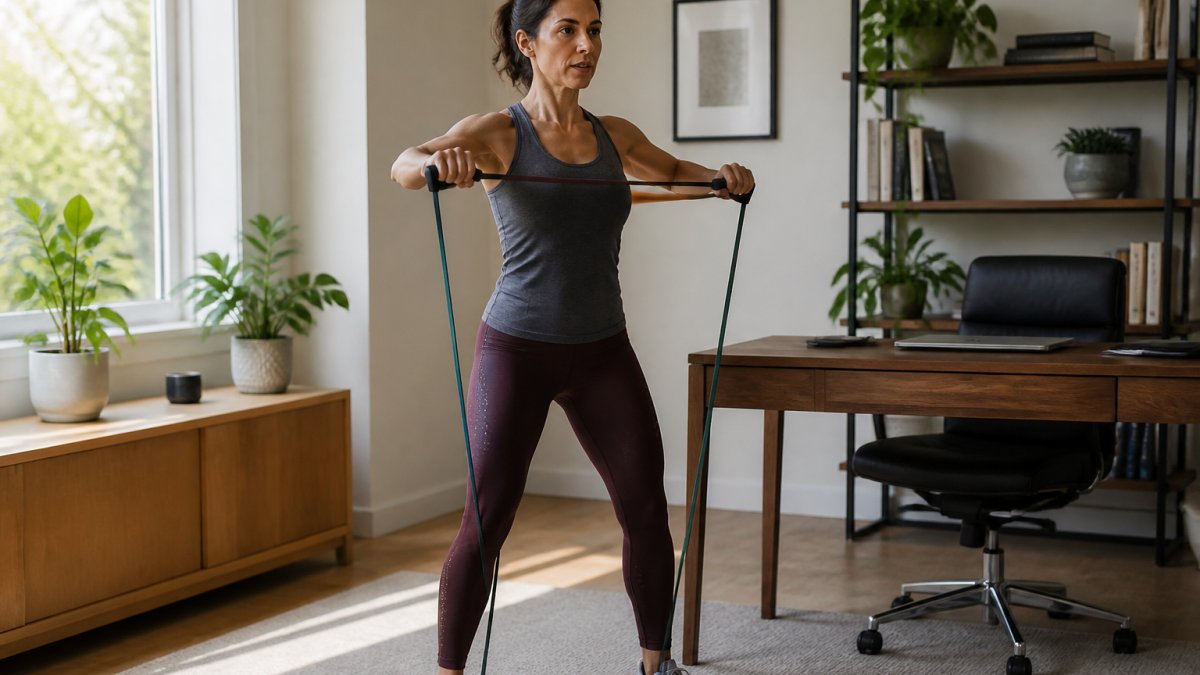
The schedule below assumes a 40-hour desk week with some meeting load and no gym membership.
| Day | Session | Duration | When it fits |
|---|---|---|---|
| Monday | Strength A | 25 min | Before work or at lunch; start the week with the session most likely to be skipped later |
| Tuesday | Zone 2 walk or cycle | 30 min | Lunch break or commute; conversational pace |
| Wednesday | Mobility and balance | 15 min | Evening or between meetings; hips, shoulders, spine, single-leg stands |
| Thursday | Strength B | 25 min | Same slot as Monday to build a repeatable anchor |
| Friday | Intervals | 20 min | Morning, before the week’s fatigue accumulates; short hard efforts with full recovery |
| Saturday | Long easy walk | 45 min | Outdoors, with family or a podcast; keep it conversational |
| Sunday | Rest and stretching | 10 min | Evening; light mobility and a review of the week |
The logic behind the placement matters more than the exact days.
A common pattern among professionals is to schedule strength on Monday and Thursday, because those days tend to have fewer social conflicts and the sessions are short enough to fit before the workday starts.
How to progress the schedule without adding hours
Do not add sessions first. Add load, duration, or difficulty to the sessions you already have, and only when the current week has felt manageable for two or three weeks in a row.
- Weeks 1 to 4: run the schedule as written, even if the weights are light and the walks are short.
- Weeks 5 to 8: add one set to each strength session, or add five minutes to the Tuesday and Saturday walks.
- Weeks 9 to 12: add one hard interval to the Friday session, or add a third short mobility block on a day that already has a walk.
Watch out: adding a fourth strength session before the first two are consistent is the most common way this schedule collapses, because it turns a repeatable routine into a program that demands recovery you do not yet have.
The fallback rule for weeks that fall apart
Travel, deadlines, illness, and family emergencies will interrupt the schedule. The rule is to drop to the minimum, not to zero.
The minimum effective week is one 20-minute strength session, one 20-minute walk, and five minutes of mobility on any two days. That keeps the habit and the strength stimulus alive without pretending a disrupted week is a normal one. When the week clears, resume the schedule at the next Monday rather than trying to make up missed sessions.
If you are traveling, replace Strength A and Strength B with bodyweight squats, push-ups, and rows using a resistance band in a hotel room, and replace the interval session with stair intervals or brisk walking. The weekly targets stay the same; only the equipment changes.
Tracking Progress, Recovery and the Weeks That Fall Apart
Track three things only: sessions completed, sleep quality, and energy levels. Anything more becomes a chore.
Bad weeks happen. Travel, deadlines, illness. The rule is simple: drop to the minimum, not to zero. One walk and one short strength session keeps the habit alive.
Recovery matters as much as training. For sleep, stress relief and recovery support, a magnesium glycinate supplement can help.
Building Your Longevity Routine With Longevity Made Simple
The hardest part of any routine is not knowing what to do. It is knowing what to do for your body, your schedule and your starting point. That is where we come in.
At Longevity Made Simple, Dr. Elizabeth Cho-Fertikh translates epigenetics research into plain, practical guidance. No hype. No fads.
Our approach gives you:
- Science-backed strategies grounded in epigenetics
- Practical lifestyle, nutrition and sleep guidance
- A realistic plan built for busy professionals
The routine is yours to build. We help you build one that lasts.
Frequently Asked Questions
What is a practical daily routine for longevity?
A workable longevity routine pairs a few non-negotiables with small daily movement. Aim for two to three strength sessions a week, roughly 150 minutes of moderate-intensity activity such as walking or Zone 2 cardio, and short mobility breaks between meetings. Add consistent sleep and protein at each meal. The point is not perfection on any single day but a pattern you can repeat for years, .
Can short workouts still support long-term health?
Yes. Short workouts for longevity work when they are intense enough or repeated often enough. A 15-minute resistance band session, a brisk 11-minute walk or a set of bodyweight squats between calls all count toward your weekly activity. The key is consistency rather than duration: three short sessions a week beat one long session you skip. Stack short workouts on busy days and save longer sessions for lighter ones.
How much exercise should I aim for to support longevity?
Common public health guidance points to about 150 minutes of moderate-intensity activity or 75 minutes of vigorous-intensity activity per week, plus muscle-strengthening work on two or more days. For a busy professional, that splits into roughly 20 to 30 minutes on most days. Start below that target if you are new to exercise, then add five to ten minutes a week until you reach it.
How do I start a longevity lifestyle without changing everything at once?
Pick one habit and hold it for two to three weeks before adding another. Most people do best starting with a daily walk and a fixed sleep window, because both improve energy quickly and make the next habit easier. Once those are automatic, add two strength sessions and a mobility break. This is how to start a longevity lifestyle that survives a busy quarter rather than collapsing in week two.
Your calendar will not clear itself, and the perfect week is not coming. Start with one pillar this week, add the second next month, and let consistency do the work. Get started with Longevity Made Simple and build a routine you can keep for the next thirty years.